
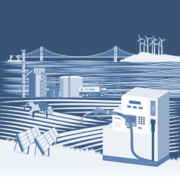
A federal clean fuel standard (CFS) for the USA

Clean fuel standards (CFSs) are regulations which reward or penalise transport fuels based on their lifecycle greenhouse gas emissions — in particular, their emissions with respect to a ‘compliance standard’ which tightens each year. A number of CFSs are already in operation around the world.

Our paper published in the journal Energy Policy examines a hypothetical CFS covering the USA’s road and aviation segments. We model two transport decarbonisation scenarios: one with an emphasis on road electrification, and the other with an emphasis on next-generation liquid fuels and CCS. Both are designed to be consistent with a net-zero-2050 target for the USA’s economy as a whole, with road transport achieving a 87-94% carbon intensity cut and aviation ∼84% (excluding contrails). The electrification-heavy scenario offers faster and deeper emissions cuts, as well as being a significantly cheaper decarbonisation option.

The development and results of these scenarios provide context for considering CFS design issues: the ambition of targets, how to drive investment, and the need for restrictions on certain biofuel feedstocks.
Global Automaker Rating 2024

Who is leading the transition to electric vehicles?

For the last few years, Cerulogy has supported the International Council on Clean Transportation (ICCT) with its annual Global Automaker Rating, an independent assessment of the world’s 20 largest automakers and their progress on zero-emission vehicles (ZEVs). The 2024 edition evaluates manufacturers across a range of indicators, including ZEV sales share, model availability, executive compensation, battery recycling commitments, and new this year, progress on adopting ‘green steel’ in vehicle production. The assessment draws on publicly available data and direct engagement with manufacturers to provide a comprehensive overview of corporate ambition and delivery.

ICCT’s annual reports track how the ZEV transition is becoming a defining feature of automakers’ global competitiveness. This year’s report highlights the rapid advance of Chinese manufacturers, who now dominate global ZEV sales. BYD surpassed Tesla in global battery electric vehicle (BEV) sales for the first time, while Chinese manufacturers secured five of the top six positions for EV sales share and led in ZEV model coverage. ICCT notes that China now accounts for more than 11 million EVs sold annually, over half the global total sales, thanks to a strong domestic market and decisive policy support. India’s Tata Motors also moved out of the ‘laggard’ category for the first time.

Cerulogy was pleased to review the 2024 assessment, verifying the source data used in calculations, checking methodological consistency, and identifying updates.

ICCT Global Automaker Rating for 2023

The second Global Automaker Rating report, published by the International Council on Clean Transportation (ICCT), assesses how global car manufacturers are placed in their adoption of electric vehicles. The report covers technology, market, and corporate governance dimensions. Having supported the first Global Automaker Rating in 2023, Cerulogy were glad to contribute once again by reviewing the methodology, data collection, and data analysis.

The ICCT Global Automaker Rating

In 2023, the International Council on Clean Transportation (ICCT) released its first annual Global Automaker Rating, assessing the readiness of car manufacturers for the transition to electric vehicles. Dr Sandford and Dr Malins supported the development of the rating by reviewing ICCT’s methodology and data collection.